In the Press, Social Commentary

Spectator Life Magazine Interview With NHYM

SpectatorLifeMagazineInterviewCoverNHYM

I was recently interviewed by the Spectator Life Magazine about private gardens in West London. My words were slightly twisted and re-arranged to fit in the article’s theme, but that’s how journalism works. Journalists find an angle and they write according to it, and top it off with some sensationalism. I really didn’t paint the Americans or the financiers in such a negative light and the ‘jealousies’ and ‘shagging’ described in the article were embellished and exaggerated. But who wants to believe that harmony lives behind closed gates? And journalists don’t want boring, they want extremes.

For those who don’t know, the Spectator is a conservative political newspaper, slanted in a conservative way. In any case, this shows that elitism envy and private gardens are still relevant and that we all still seek that patch of green in the middle of London chaos: http://life.spectator.co.uk/2015/12/notting-hell-how-fierce-rivalry-and-oneupmanship-defines-life-in-the-garden-squares-of-west-london/

Spectator LIfe MagazineInterviewNHYM

So, please note that my original title from my post ‘The Garden Wars’ has ended up in the article: https://nottinghillmummy.com/2014/11/06/notting-hill-private-gardens-the-garden-wars/

Perhaps I should just feel flattered that others like to re-write my articles and print them.

xx

NHYM

http://www.nottinghillyummymummy.com

@NHyummymummy


Standard
Family Life, Social Commentary, Top 10

Top 10 Tips: How To Raise Resilient Children

This blog was originally conceived as a way of escapism when I was faced with adversity and I had always wanted to keep it slightly surreal and fictionalised in the NHYM world. But we really are living in a time of high alert and we are all a bit more nervous than before that it would be impossible for me to ignore what is going on. So, to keep this post on a positive note and instead of just feeling helpless, it has led me to research and write about how we can teach our children resilience.

We all think that all we want is for our children to be ‘happy’ but this is too simplistic when reality will throw traumas, tragedies, and disappointments at us, some of which are out of our control. We, as parents, instinctively want to protect our children, but there comes a point when we can no longer protect them. What we can do, is to teach them resilience and how to bounce back from life’s challenges.

Here’s a round up of my Top 10 Tips on How To Raise Resilient Children: 

(researched on the internet and parenting books)

  1. Don’t accommodate every need: If children are never exposed to uncomfortable situations, they will never learn from them and how to handle being in such situations. Minor uncomfortable situations will teach them flexibility and how to react positively.
  2. Avoid eliminating all risks: Allow appropriate risks for them to learn their own limits.
  3. Teach them to problem solve: You won’t always be there to solve their problems. Teach them how to go through the process of solving a problem to equip them with their own problem solving skills.
  4. Don’t provide all the answers: Don’t immediately rush to answer all the questions your child may have. Show them how to answer their own questions, promoting inquisitive minds and how they can answer their own questions.
  5. Let your kids make mistakes: Failure can be a good thing (but not too much!). It teaches them that failure is OK and that they can learn from their mistakes. See it as a growth and learning experience rather than as a negative experience. We all make mistakes, and it is important to children to know that it is Ok to make them.
  6. Help manage their emotions: Teach your children that emotions are OK, but that you have to figure out what to do next and how to manage them. For example, if they are upset at a friend, try to teach them to tolerate the emotions but that they will pass.
  7. Model Resiliency: Try to show them resiliency and be calm and consistent. We could probably all learn from this list.
  8. Determine your child’s strengths and develop them: Rather than focussing on their weaknesses, build on their strengths for them to build their confidence and know that they have their own unique talents and strengths.
  9. Build their coping skills: Everyone will face a situation when things aren’t going their way. Teach them to accept things that he/she cannot change, normalise their experience and let them know that they will get over it and get stronger from it. Positivity is also a helpful.
  10. Teach children to be independent but seek help when needed: There comes a point in each child’s life when they will no longer have their parent at their side every moment of the day to support, cheer, and help but that they can ask for help when they need it.

So, in these times of stress, what we can do is teach our young children to become resilient, leading them to become resilient and strong adults. Let me know if there are ways you have helped to build your children’s resilience.

xx

NHYM

http://www.nottinghillyummymummy.com

@NHyummymummy

Standard
Family Life, Social Commentary

Top 10 Tips: Children & Screen time

Unknown

Photo courtesy of the internet. NHYM 2015. 

I was reading an interesting article on children and screen time this weekend in the Times, Screen time and your child: what every parent needs to know, so thought I would share the most salient and pertinent points of the article:

  1. Professor Sonia Livingstone at LSE, a researcher on children and technology and an advisor to the UK Council For Internet Safety, thinks that parents need new guidance away from thinking purely in terms of time limits, towards sharing more of what their children are doing online.
  2. All screen time is not equal; we need to look at the quality of what our children are doing online; are they creative or passively consuming. ‘The challenge is for parents to work out whether they are doing something creative and imaginative or something mindless.’ says Professor Livingstone.
  3. On setting time limits: ‘If they are getting the grades you hope for and expect, if they are lively, creative, talkative and able to develop interests and hobbies, those are indicators that your child is fine.’
  4. Keeping an eye on the balance is key: Are they playing sports, going outside enough, and getting enough face to face interaction?
  5. More than three and a half hours a day on social networks is linked to low self esteem and depression. One study showed that the happiest 10-15 year olds spent no more than one hour a day on social networks.
  6. Aric Sigman, a psychologist, has come up with some time limits. He recommends 30 minutes to 1 hour a day of recreational screen time for 3 to 7 year olds, one hour for 7 to 12 year olds, 90 minutes for 12 to 15 year olds, and two hours for teens aged 16 and over. Wishful thinking. But it’s a good goal.
  7. Start having screen time with the family: make time each week where the whole family goes online and shows each other interesting sites or fun things they’ve discovered. Livingstone recommends one hour per week.
  8. For 15 years the American Academy of Paediatrics has recommended no screen time at all for under twos, but there is evidence that short bursts of time on interactive educational apps can help two to five year olds learn, says Dr. Gummer, a psychologist and play specialist.
  9. Teach your children responsibility about screen time. For younger children, you may need to set time limits and routines, for example two hours a day is accepted by many experts and police them. For older children 11 and over, it’s important to involve them in the process. ‘Parents should help them make decisions rather than trying to control every click which is impossible anyway. They need the skills and resilience to make sensible choices, which are the same skills they need to do their homework and going to bed. Parents can help them get into routines and explain to them that more than two hours a day of screen time is too much.’ says Dr. John Coleman, a teen psychologist researching a book on parents and screens.
  10. Have a screen free day. Boredom is a very important educational skill  because it gives them time and space to create and think about the things they want to do. Coleman recommends one totally screen free day maybe once a week.

Excerpts from The Times Saturday September 12, 2015 

xx

NHYM

http://www.nottinghillyummymummy

@NHyummymummy

Standard
In the Press, Social Commentary

Bloggerrant & Why I am Blacklisting Tatler: NHYM Interview with Tatler on Children’s Birthday Parties

TatlerCoverSept2015NHYM

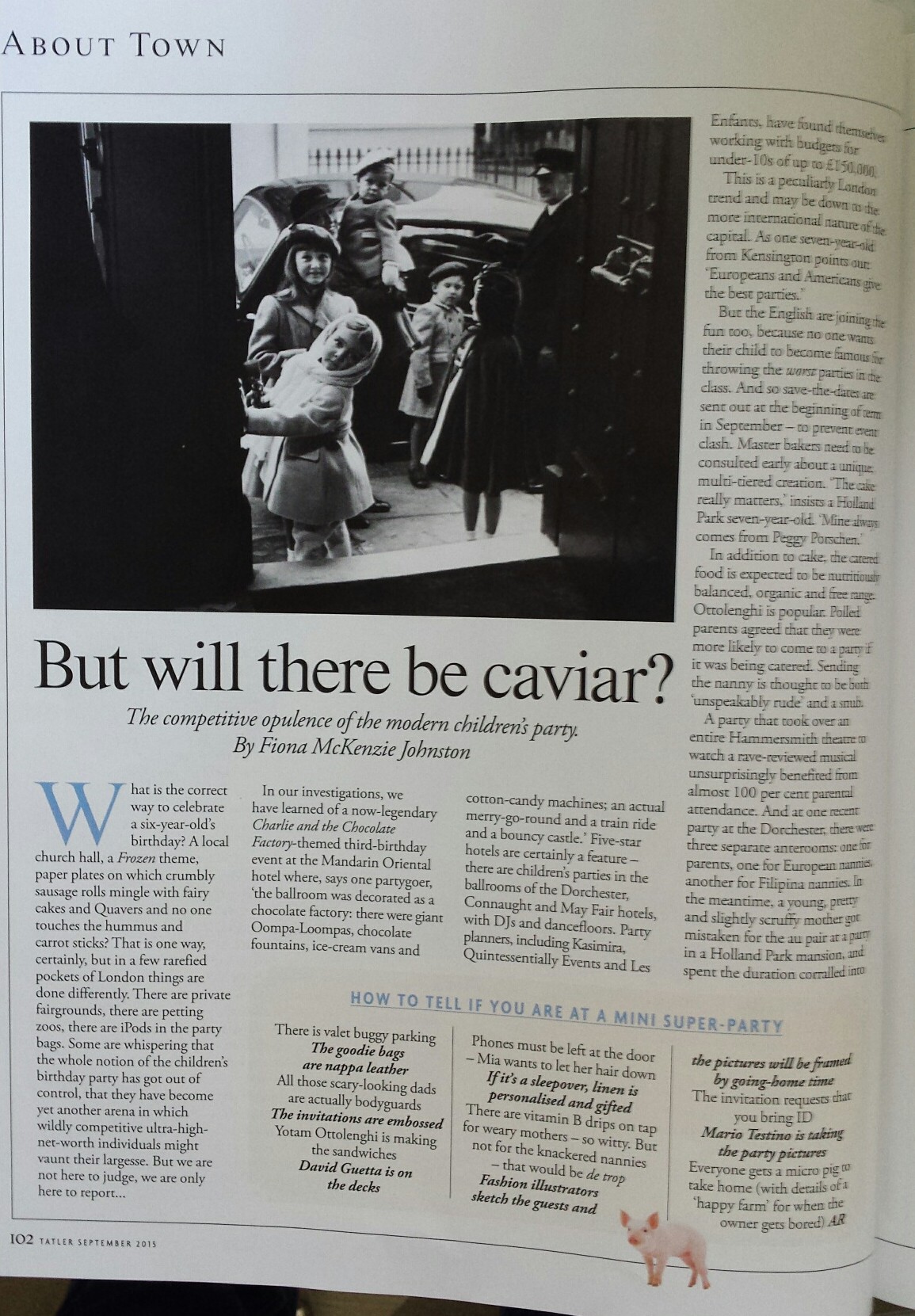
Tatler September 2015 Issue. Interview with NHYM on ‘How to Throw the Ultimate Children’s Party’

I was recently extensively interviewed on the SuperRich’s children’s birthday parties for the September Issue 2015 of Tatler. I spent an hour speaking to the writer and gave her lots of juicy morsels of gossip like where the SuperRich throw their children’s birthday parties (5*hotels), which celebrities rent out all of Bramley’s (Beyonce for Blue Ivy) or which stars rent out suites at the Dorchester for their children’s birthdays. In exchange, I always expect some kind of credit in the article. Below is the article. Now, I wasn’t credit once, whereas I really did write half of that article. Well, 75% of the content in that article is mine. Half from my Blogpost: https://nottinghillmummy.com/2014/06/05/kids-birthday-parties-these-days-nobu-or-the-dorchester-darling/ and half from the interview.

Children'sPartiesTatlerNHYMTatlerChildren'sPartiesPage2NHYM

  • The story about Charlie and the Chocolate Factory-themed party at the Mandarin? It doesn’t actually exist, it was a story that I changed to keep the privacy of the family throwing it. This was purely a ‘copy-and-paste’ from my post.
  • The mention of the 5 star hotels as a current favourite? That was from my numerous invites to the various hotels, also included from my post.
  • Party planners Les Enfants and Quintessentially? Another of my tips & hints from my post.
  • The quote ‘no one wants their child become famous for throwing the worst parties in the class‘ was my actual quote, word for word.
  • The save the dates sent in September? Also a phenomenon in my daughter’s class.
  • The 7 years olds Netjetted to the Alps? The actual story was that they were jetted to Africa for a Safari, so another blatant journalistic error.
  • Renting out the whole of the Electric Cinema for a birthday party? Yes, indeed, another of my comments.

Sadly, the self-serving, self-absorbed writers and editors of this magazine truly do not improve their reputation by rubbing bloggers the wrong way. The Devil Wears Prada was a hit for a good reason. So, this is why I am blacklisting Tatler, their editors and writers. It is basic plagiarism, and really shows their lack of originality by copying a blog post. I don’t get paid to write my blog, neither do I for any interviews. The least I can do is try to get credit for my work. In this case, this media outlet has failed to do that, which is unprofessional and downright offensive.

Next time I get called by a magazine writer for an interview, I will think twice about working with them. Perhaps this is an indication of what some magazines are today: irrelevant and a dying breed, trying to hold onto their circulation numbers by plagiarising other people’s work.

xx

NHYM

http://www.nottinghillyummymummy.com

@NHyummymummy


Standard
Family Life, Social Commentary

‘Teenage Daughters Mental Health: Please take care of Y(our) daughters…’

images-1

I was having a rather disturbing conversation with a mother of a tween and teen who sends her daughters to arguably the most academic and rigorous girl’s school in Central London, which promises futures of Oxbridge and of ruling the world. She told me that about 50% of all the girls at this said school were suffering from moderate to severe psychological problems, which if you compare it to the normal teenager’s prevalence of 20%, is rather shocking.

What?

She described all kinds of psychological problems in these girls; depression, self-harming, eating disorders, anxiety and suicidal thoughts. It is normal for teenagers to have a higher than normal rate of psychological illness, during a time when hormones are raging, identities are being questioned and formed, and when teens are just more vulnerable and sensitive than most. It is not normal for it to be 50%. That is one out of two girls with bulimia or anorexia, depression or anxiety and others who end up with diagnoses and therapists. Some girls are throwing up during lunch breaks or eating appetite suppressant pills to lose weight. Others discussed their suicidal thoughts with their peers, almost as if it was ‘cool’ to be suicidal, calling their friends and telling them they were going to ‘do it’. Others yet are being diagnosed with more complex illnesses such as Bipolar Affective Disorder and Personality Disorders, requiring inpatient treatments and hours of therapy.

‘I can’t understand why this is happening’

The mother, whose children are well-adjusted and happy, couldn’t understand this shocking phenomenon and couldn’t explain why it was happening. Some people have idiopathic depression, when depression just happens without a cause and may be genetically linked. But in this very specific case in a closed school environment, where there is a higher than normal prevalence of psychological problems, it is obvious that there are triggers. Is it the school, the parents, social media or the peers? The answer is probably a bit of everything and probably dependent on the individual.

The School?

She thought that it wasn’t just in this particular school, but that these problems were apparent in many of the top London schools. The pressure that teens experience every day comes from everywhere: top academic schools which push children academically, even those pupils who probably shouldn’t be at these schools. Pressure from parents who push their children to excel and also fill their days with academic and extra curricular activities. Peers who compare themselves to super models. The ‘myth’ that parents tell their children that they ‘are always the best’. www://www.telegraph.co.uk/education/educationopinion/11643947/We-know-whats-wrong-in-education-so-what-are-we-doing-about-it.html

Another parent, this time from a boy’s school of equal scale, thinks it is a personality type, that hyper-competitive, bright and academic types tend to have behavioural issues, boys in a Asperger’s Syndrome and compulsive kind of way and girls with Eating Disorders and mental health issues. He mentioned that the top boarding schools also have problems, and that it isn’t just endemic in London schools. One of his friend’s daughter had to leave her top-of-the-league boarding school under distressing and difficult circumstances.

Unknown-1

Parents

We all know pushy parents. Need I say more?

Malaise of the Rich

One mother, rather unsympathetically, thinks that it is the malaise of the rich: they have no ‘real’ problems that they create problems for themselves. The poor in Sudan and Ethiopia aren’t worried about how small their waist line is. They are just hungry. The Syrian refugee children don’t worry about which top school they will get into, they just want a roof over their head. The ‘rich malaise’ may have some impact, but I don’t think it is the only or the root cause of all of these problems.

Control & Attention

Teens are in that awkward, transitional stage where they don’t completely depend on adults but also can’t be completely independent. There is a lack of control of their surroundings, unable to exert their independence yet wanting to. They have, in fact, little control over anything. Their bodies are changing. School at that age is prescriptive. They don’t have a choice how late they stay out or how they spend their money. Their parents splitting up and using them as a bargaining chip is beyond their control or understanding. This lack of control sometimes manifests itself in controlling what they can: eating. Bulimics and Anorexics use these tools as a way of gaining control of what is out of their control. Often there are problems at home or at school and this is their way of expressing themselves. Sometimes, it can be a call for attention and that something is not right in their life.

images

Societal Pressure

The pressure on teenagers in urban schools is beyond what most normal teens have to endure. Not only do they have excel academically to ‘get into Oxbridge/Ivy,’ they have to excel at extra-curricular activities, be popular, and look like Gisele Bundchen. These are unrealistic expectations that are placed on our children by parents, schools, the external world and society. Yes, it’s lovely to have Natalie Massenet as your role model, but it’s OK not to be her. Of course, it would be lovely for our children to succeed and achieve, get that 1st class honours from Cambridge, become Stephen Hawking, but that is obviously not the destiny for most.

Social Media 

It has just been revealed that the level of Eating Disorders hospital admissions to specialist mental health centres for adolescents 13 to 19 y.o. has nearly doubled in the last few years, from 959 in 2010/2011 to 1,815 in 2013/14 http://www.bbc.co.uk/newsbeat/article/32975654/eating-disorder-hospital-admissions-nearly-double. Dr. Carolyn Nahman of the Royal College of Psychiatrists believes that social media is a huge concern as it creates social media pressure for these young girls to look perfect and model-like. There are ‘thinspiration’ websites that glamourise being thin and there are pro- anorexia ones which will wake you up with what is happening on the net. This is a general societal problem rather than just a problem of the super academic and the super rich, but how do we address it?

Unknown-5

Family 

Family problems can be a cause of stress and anxiety on young, vulnerable teenagers. Parents fighting, parents divorcing, or not having a stable family. Parents should sometimes look at their own behaviours and look at how they may be impacting their child’s. We may overestimate our children’s abilities to cope, just because they may not overtly express their emotions, mostly because they don’t fully know or understand their emotions yet.

Stress 

Teens are highly susceptible to the effects of stress but most parents either don’t see it or can’t see it. For those over-scheduled teens who suffer from mental illness, it would be useful to take a step back and look at their lives. Many of them have a rigorous academic schedule and exams which all lead to Oxbridge or the Ivy Leagues. Then they must excel at Netball or swimming or Track and Field to stand out from the rest. There is little time left to be a child, or even to spend quality time with their parents and friends.

If you look at the stress curve, there is a certain level of stress that is beneficial to people, which motivates and drives them and increases their productivity, but once you pass that beneficial threshold, it becomes a detriment to the work and then to the person. For many of these teens, they have gone past the threshold that is beneficial and quickly enter the panic/anxiety part of the curve, missing out on the exhaustion part because they are young, resilient and have more energy than you or me.

stress-curve-19168698

I think that parents, schools, and other external factors are all pushing our daughters over the limit of their thresholds and we aren’t stopping them in time. Whatever the child’s problem, it is the parent’s duty to try catch it and try to address it, even though sometimes it is impossible. But it is our duty as parents to at least try and be aware of it.

What to do? 

As I see my daughters growing up, already mimicking and role playing Snow White and the Seven Dwarves, asking who is the ‘most beautiful of them all’, I wonder how I will protect them from the world and these overwhelming feelings that you can have as a teenager. What would I do if my child was suffering from depression and self harming I think to myself. Perhaps it would be important to look at their life as a whole, their home, their school situation, their friendship situation and then make some major changes. Perhaps it is our duties as parents to try to provide them an environment that is more suitable to them rather than put them in a situation that suits us and society. We all hope to have brilliant children, and although some thrive in their brilliance, others are crippled by it and it manifests in these psychological conditions.

Foresight

Having been through the teenagers years, I sympathise with these girls, who don’t yet have the coping skills that are acquired over a lifetime to deal with new emotions and challenges, and resort to these detrimental behaviours. For any parent that has a daughter or a son with behavioural problems, beware of the creeping clues and signs in their behaviours and do your best to address them early on. It can take years for mental health problems to develop, so perhaps spending more time with your children will let you see these problems crop up sooner than later, or maybe enable your child to confide in you if they are having difficulties. Getting into Oxford is after all not that important, but having a happy child certainly is.

xx

NHYM

http://www.nottinghillyummymummy.com

@NHyummymummy

Standard
Family Life, Social Commentary

‘Are you a ‘Boardroom Mom?’

images-6

Every class has at least one or two of them. A ‘Boardroom Mom’ that runs her children’s life with the same determination and precision as running a Fortune 500 company, full of back-to-back appointments, targets and desired outcomes. Come to think of it, 90% of moms I know are one version or another of a ‘Boardroom Mom.’ Boardroom Moms can be described as overqualified, overeducated and overachieving moms who ascribe to what anthropologists call ‘intensive parenting.’ I just read an article over the weekend ‘Poor Little Rich Women, by Wednesday Martin, a social anthropologist who is coming out with a new book on the ‘Upper East Side’ tribe of ‘Glam SAHMs’ (Glamorous Stay-at-Home-Moms), in which she criticises these women, who put all of their ambitions on their children and ‘over-parent’ in more ways than one (And to answer your question, no, I have never heard of wives bonuses and, yes, I think they are crazy or at least just a joke).

I only realised that I fell into this category, despite promising myself I would never be one of them, when my nanny was away and I tried to look after my children all on my own and realised that it was actually physically impossible to be in two places at one time. While one was at swimming class, the other was meant to be at a music class. One was meant to be dropped off at one school and the other at the other school at precisely the same time. When there are two people running this schedule, this type of scheduling works. But without two people, this schedule falls flat on its face. You may think I am an extreme, but other friends have excel worksheets of their children’s schedule. I consider myself average on the scale of ‘Boardroom moms.’

A lot of people without nannies wonder what women do who are Stay-At-Home-Mums and have nannies looking after their children. Most think that they are mani-pedi-ing, Yoga-ing and blowdry-ing most days. And some do and are of minor interest. In my case, I am guilty of over-scheduling my children and running my household as if I have two single children. Each has its own separate and unique schedule that completely does not coincide with their sibling’s. (I read some random article that guilted me into thinking that having more than one child means that the second will always be neglected, therefore decided to treat them as separate beings and entities, just because I can, but clearly not always to my benefit. Don’t believe everything you read). This keeps me busy and overstretched and my children believe that there should always be two people looking after them, to their detriment. But in the end, all I was trying to do was to be a good mother.

The trouble really is that I and so many women of my generation were raised thinking that we were going to rule the world. We were told to work hard, be independent, have careers, be equals to our male counterparts and that we could do whatever we put our minds to. So, as part of this generation of post feminist women, we all scrambled to get great degrees from the top universities, climbed the requisite career ladder and reached our goals of succeeding in our careers. Prior to motherhood, we were praised when we achieved a top degree, when we were promoted or did a great job or got a bonus that allowed us to buy that Chanel 5.0 or those Louboutins on our own salary. It filled us with pride. We were important cogs in the wheel of society.

But then, after reaching these top jobs or positions in a company, motherhood hit and these ‘top jobs,’ seen so highly valued by society, did not often work well with the trials and tribulations of motherhood. For example, my job sometimes meant working until midnight, working on weekends. It was not a flexible job where I could drop everything to take my kids to the doctor if they were sick, be there to do a ‘book reading’ at school or to attend any of the multitudes of events put on by the school; Christmas plays, Christmas fairs, bake sales, parent coffees, Sports Days, Parent teacher conferences, and the list continues. There are some ‘top’ jobs that allow that flexibility, but for the most part, with these types of jobs in banking/consulting/law/any demanding high-flying career, you are either in or out. You either let nannies raise your children, which is fine and you can plough on with your career, or you are out, and become one of these Glam SAHMs.

After trying the whole work-motherhood balance and even part-timing, I realised that I couldn’t do both well. I was too groomed to be perfect at what I do and not to tolerate my own mediocrity. When at work, I tried focusing on work, but motherhood kept interfering; sick children, sleepless nights, school events and of course the biggest monster of all, guilt. Then at home, I was tired, stressed and would worry about not being there with my children for each and every milestone. Like a friend who missed her child’s first steps because she was out of the country on a work trip. Can you live with that or not? is the question many moms have to answer. My answer was that I soon quit and became a full time mother. I chose to be at home because that was my personal priority, but also because ingrained in my DNA was this primal, instinctual, uncontrollable need to be a parent, whether I wanted to or not. Others of course choose work, which I completely understand and often admire, but for me, the pull towards motherhood was stronger.

So here I am, a full time mother with so many degrees under my belt, so overeducated and so overachieving, so disciplined and organised, doing what apparently nannies can do just as well as me or perhaps even better (if you read the articles about full time working moms and their children being just as happily raised by their nannies, you wonder why you do it at all – you just can’t win as a woman). That’s when over-parenting, ‘intensive parenting’ comes in. We, as highly educated and highly intelligent women, are left with running a household and raising children, with the skills of CEOs, accountants, managers and leaders. That’s when we put all of our energy into raising these ‘perfect kids’ because we have achieved so much in our prior lives that we expect that we can do the same in a domestic setting. We don’t know how to handle mediocrity. We want to be the ‘best parent’ we can be, just as we tried to be the best lawyer/banker/worker. Perhaps it is out of frustration, or perhaps it is the only way can be.

Then, once you become a full time mother, there is no more praise or quantifiable, measurable achievement or metric of you as a mother. That’s when ‘getting into the right school’ becomes an obsession and we put in all our energies where we can get an actual reward as a mother and we can proudly stand tall and tell someone at a dinner party that so-and-so got into ‘St.Pauls/Westminster/Oxford/Harvard’ as a praise to us as parents. We are using our children’s achievements as personal praise, which is just so wrong, and which I strongly try to resist in the midst of parental madness, herd immunity and peer pressure. But I understand where it comes from. I miss receiving praise for the work I have done, to feel good about myself because of some sort of achievement, and the ability to proudly tell someone what I do for a living. Instead, just last weekend at a dinner party, someone asked what I did, and I replied ‘I take care of my 2 children,’ and the conversation pretty much ended (which ultimately, I understand, because I also want to talk about other things than talk about my children).

It is my own fault for not taking more pride in what I do day in and day out, but I miss being part of a team, of being useful in a different way than changing nappies, co-ercing my children not to eat with their fingers or ensuring that homework is finished on time. I miss having quantifiable, measurable results and rewards. Even though nothing can replace the hugs and kisses I get from my children, I still miss the achievements I once had, and can only remember them as if they were part of a distant past or another life. Instead, I am led by my maternal instincts and plan my children’s future. I plan their weekends and their playdates. I make sure they are learning ‘essential life skills’ like swimming, a second language and sports, to be polite and responsible citizens. But a part of me deeply misses the old me and hope that one day, she will be back.

So instead of criticising these Glam SAHMs, perhaps the real question we should be asking ourselves, now 50 years after Betty Friedan’s ‘The Feminine Mystique,’ is how to find a way for all these overeducated, overqualified women to use their skills usefully in society, without compromising their role as a mother.

Let me know your thoughts.

xx

NHYM

http://www.nottinghillyummymummy.com

@NHyummymummy


Standard
Social Commentary

‘What Postcode are You?’ London’s Poshest Postcodes…

I used to be what you could call a ‘Chelsea Girl’ about 10 years ago, with my SW3 postcode, Saturday lunches at the Chelsea Farmer’s Market and drinks at Eclipse on Walton Street. Then, I moved up ‘North of the Park’ where I swapped King’s Road for Westbourne Grove, Eclipse for the Westbourne Pub, and Saturday lunches at CFM for Daylesford lunches and went from ‘Chelsea Girl’ to ‘NHYM’. As a Chelsea girl I remember thinking that Notting Hill was a) not as pretty b) a bit grungy/scary c) a little ‘too cool for school,’ but I followed my other half and 10 years later, all the remnants of ‘Chelsea Girl’ are well behind me and with two kids in tow, I have fully embraced the Notting Hill ‘cool.’

I recently wrote a short piece about London’s most expensive postcodes and the bankers who want to live there. http://news.efinancialcareers.com/uk-en/205575/6-london-postcodes-that-show-youve-made-it-in-banking-and-the-bankers-who-live-there/. It got me thinking about London postcodes and how we identify with them. So what does your postcode say about you?

Zoopla’s Rich List of the most expensive postcodes: http://www.zoopla.co.uk/property/richlist/uk/england/

Highest value areas
Area Zed-Index
1 W8 (Kensington) £2,707,386
2 SW7 (Knightsbridge) £2,493,204
3 SW3 (Chelsea) £2,324,889
4 SW10 (West Brompton) £1,857,677
5 W11 (Notting Hill)

Here is my guide to London’s Most Expensive & Poshest Postcodes:

18-Hyde Park

1. SW1X: Knightsbridge

Your neighbours: Sheiks & Oligarchs

Your Style Icon: Queen Rania of Jordan

Knightsbridge is Blingland. It is home to One Knightsbridge, one of the world’s priciest residences where Sultans, Sheiks and Oligarchs love to mingle with their own kind. For them, the postcode and address are clearly more important than cost per sqm. Their motto is ‘the more expensive, the better.’ Of course with Harvey Nics and Harrods at their doorstep, shopping is a vital past time for the SW1X residents. They love labels, flashy cars, yachts and PJs. Competition is rife amongst the SuperRich, and Knightsbridge is the perfect place for them to show off their latest bling.

images-2

2. W8: Kensington

Your neighbours: Kate Middleton & Tamara Ecclestone

Your Style Icon: Kate Middleton

With Kensington Palace and Kensington Palace Gardens, W8 has won the trophy for the most expensive postcode in the UK. It is easy to see why the SuperRich drop £75 Million for a house on Billionaires Row, aka Kensington Palace Gardens, with Hyde Park and Kensington Gardens as their backyard. Then just a few streets away, Phillimore Gardens houses will keep you drooling, which is the best place for Halloween Trick or Treating, with a competition for the best, excessively decorated house on the street. Kensington divides the Chelsea set and the Notting Hill set who are constantly competing for ‘best postcode.’ Ideally located with Holland Park to the West, Hyde Park to the East, South Kensington to the South and Notting Hill to the North, no wonder it is considered the Billionaires Postcode.

bang_26536_p

3. SW3: Chelsea 

Your neighbours: Charles Saatchi, Roman Abramovic, and Hugh Grant

Your Style Icon: Amal Alamuddin (Amal Alamuddin may appear straight out of Chelsea, but she is in fact a Notting Hill Girl). 

Chelsea used to be for Sloaney Poneys and the Posh British set, but times have changed. Even the ‘Made in Chelsea’ cast can’t afford to live in Chelsea anymore. Hugh Grant remains one of the last Chelsea Toffs that can be seen toffing around in Chelsea at Brinkley’s on Hollywood Road, right around the corner from his house (unless he moved since my last sighting). Nowadays, it is rich American Private Equity and Hedge Fund kings who sweep up many of the Chelsea Square mansions. The Chelsea set tend to be immaculately dressed and coiffed with head to toe Chanel or Ralph Lauren, thanks to the Chanel store on Brompton Cross or Ralph Lauren on Fulham Road. They do tend to think that ‘it’s Chelsea or nothing’. Chelsea is beautiful, immaculate and manicured, home to the Boltons, some of the most expensive London real estate. But let’s be real, Chelsea is like that really, really good looking guy, who knows it.

South_Kensington_(film)

4. SW7: South Kensington

Your Neighbours: Italian and French Aristocrats

Your Style Icon: Marion Cotillard, Clemence Poesy

South Kensington used to be ‘the’ place for all the Italian and French to decamp to from Paris, Rome or Milan, helping to make London France’s 6th biggest city with 400,000 French inhabitants. The French of course love it so much that it has the French consulate and the Lycée Francais within 2 blocks of each other. There is even a French street, Bute Street, with a French bookshop and delis filled with Lycée boys and girls. For the French who want a piece of France in London, South Kensington is the ideal place. Their Mediterranean neighbours, the Italians, equally love South Kensington, paying homage to it with the 2001 film with the same name, South Kensington. The Italian aristocrats can’t get enough of South Kensington, and you may just find yourself on one of their 42 m sailing yachts off the coast of Capri if you’re lucky enough.

images-4

5. W11: Notting Hill 

Your Neighbours: Stella McCartney, Richard Curtis, Writers, Musicians and Fashionistas 

Your Style Icon: Stella McCartney and Kate Moss

It used to be that Notting Hill was the edgy, cool, hip Postcode, but with the 1999 Notting Hill movie and the Bankers and Funders entering the neighbourhood, Notting Hill has gentrified and become the home of the NHYMs and those artists that have ‘made it’. Some of the Modelistas, such as Elle McPherson and Claudia Schiffer have left, but the newer and younger ones like Arizona Muse have moved in, and Stella still remains. It is also popular with many musicians like Blur and Coldplay musicians and Adele reportedly bought her first house here in NH. Notting Hillers like to think themselves as cooler and hipper than their Chelsea counterparts, but the reality is that they both drive their Black Range Rovers, carry a Bottega Veneta handbag and shop at Net-a-Porter but with a rock chick look like Kate Moss. W11 though still prides itself of its multi-coloured homes and magnificent Private Gardens like Ladbroke Square that most can only dream of.

So what your thoughts on your Postcode?!

xx

NHYM

http://www.nottinghillyummymummy.com

@NHyummymummy


Standard
Social Commentary

‘T.L.C.: Tinder-Loving-Care…’

images

I was having dinner with a friend of mine, let’s call him Karl, at the Arts Club a few weeks ago when we came upon the subject of Tinder. You see, Karl is circling his 40s and is one of those eternally single guys who dated models in his 20s, a TV celebrity in his 30s – which was serious until it wasn’t – and is now pure and simple ‘single.’ We all have one of those friends, don’t we? Edging his 40s and still unable to settle down, roaming the streets of London entertaining his married friends with his Tinderadventures.

Tinder is a slight obsession of mine, since I am 10 years too late for this cyber-phenomenon (remember the days of Speed dating and Match.com? I even missed those days) and I have often wondered what Tinder-dating is actually like. Would I have been a Tinder-dater if I had been single during Tinder-Time? Would I have been mostly swiping Right or swiping Left? Is it just an instant hook up or relationship worthy material? Who are all these Tinderers? It is actually fascinating, considering Tinder started only just over 3 years ago.

So, Karl gave us a Tinder Tutorial and explained how it all worked for us Middle Aged Tinder Virgins. He showed us the profiles of some girls he had swiped Right for: there was everything between a 5 and a 10. Karl didn’t seem to know the difference between a 5 and a 10, I thought to myself. One woman had for a profile picture, a picture of her enormous double DD cleavage. Classy, I say. He laughs. Perhaps this was why he is still single, I tell him. Sometimes, for the fun of it, he swipes right 10 times in a row just to see what would happen, he explains.

He had also been ‘around the world in Tinder’ he tells me, using it even when he was in New York, Hong Kong and Tokyo on business. (Apparently Tinder New York is more about instant sex, whereas Tinder London has more ‘looking for a relationship’ members). This is truly a global app, I think to myself. The ‘Uber’ of dating. He even went places where he had no more swipes to do! He actually came to the end of Tinder, who knew you could actually get to the end of Tinder?

I ask him if Tinder actually works and he tells me that apart from one Tinder-relationship he had for two months, it is soul-destroying. He was having 15 simultaneous conversations with 15 different girls but was not planning on actually meeting any of them. He just wasn’t interested in any of them but wanted to stay ‘connected’ so that he had someone to talk to when he was lonely or bored, without having an actual, IRL, demanding relationship.

Another friend of mine also on Tinder told me about one Tinder relationship she had with a guy she had met once but he then never made an attempt to meet again but would send her photos of where he was traveling and send random texts to see how she was doing. I wondered what kind of need this was fulfilling in these people’s psyches, if it wasn’t even about sex.

I began to wonder what the point of Tinder was until my husband came home and told me about the actual magic of Tinder: his recently divorced friend came raving to him one night about the merits of Tinder. He had just gotten divorced and was needing some ‘loving’ from someone, anyone, to lift him out of the deep self-esteem-hole he had gotten PD (post-divorce). Enter Tinder-Loving-Care, when two swipes make a right, and rebound sex/attention is on tap. For a divorced, middle-aged father of 2, with a social life solely based on happily married couples from ‘couple dinners’ with his wife’s friends, Tinder was a godsend. Instant TLC at the swipe of a screen, nothing like it for morale and self-esteem boosting.

xx

NHYM

http://www.nottinghillyummymummy.com

@NHyummymummy

Standard
Social Commentary

‘How to Spot an Alpha Man…’

images

‘Are you a Turtle or a Tiger?’

I was recently talking to someone in the US who had been to ‘group pre-wedding counselling’ (who even knew those existed?), where they were each asked if they were a ‘Turtle’ or a ‘Tiger’ to determine their compatibility score. I told her that this question would never be asked in London, since everyone here is a Tiger. The Alphas are everywhere. To survive in the urban jungle that is London, men don’t really have a choice than to be Alpha; driven, ambitious, focused, dominant and powerful. A recent survey showed that 79% of single women want a dominant man, especially in the shape and form of Christian Grey, which is apparently why ’50 Shades of Grey’ has been such a success.

So what exactly is an Alpha Man? Kate Ludeman described him as ‘powerful, authoritative personality types’ who ‘tend to be aggressive, results driven achievers who insist on top performance from themselves and others’ in her book ‘The Alpha Male Syndrome’. http://www.worthethic.com/the-alpha-male-syndrome.html

‘Are you Alpha-Alpha or Alpha-Beta?’

But I think that there are subtypes of Alpha Men: There are the Alpha Alpha (AA), the prototypical Aggressive & Arrogant types, who want to win as the end goal, and tend to put their needs in front of everyone else’s. Then there are the Alpha Beta (AB): Alphas but with a softer side. Those can also be called the ‘Blenders’ and tend to be driven when needed but can put your needs in front of theirs (Alpha Betas are a rare breed, so if you have one don’t let him out of your sight). Alpha traits all make for very successful men in the work place, and 79% women are attracted to these kinds of men, but what is it really like being with an Alpha Man? And how can you spot an Alpha Man?

Ten Ways to Spot an Alpha Man…

images-2

1. ‘Transition Time’:

When they come home from work, they need a half an hour to an hour of ‘transitioning time’ from their ‘work selves’  to their ‘normal selves’ and only then can they have a normal conversation. For those 30 minutes/hour, keep clear from a) nagging b) asking them anything too important c) whining about how hard your day was. If you don’t listen to this rule, he may mistake you for his assistant or a colleague. Which is not a good thing.

2. Crackberry Addiction

At dinner, you will need to fight with the Blackberry, his other mistress, for attention. Despite house rules of ‘not using technology at dinner’ he will always find a way to get on his BB and get distracted by yet another ‘very important email that needs to be answered right away.’ At fancy restaurants, you can always spot an Alpha Blackberrying emails while you wait for your starters, or you can see him pacing back and forth in front of the restaurant on a ‘work call.’

3. Last Minute Cancellations

You will always need a Plan B. When planning a holiday, you need to prepare a backup plan like a girlfriend or your mother to go on holiday if his work makes him cancel the holiday at the last minute. Or at least always book changeable, refundable tickets.

I once went to a work dinner as an Alpha’s date, and as soon as we sat down, he had to leave to go back to the office to ‘finish up a deal’, while I was left entertaining his two 65 year old clients at George. My revenge? Choosing the most expensive thing on the menu: white truffles. Sold by the gram. Let’s just say that I made sure no one else in the restaurant, apart from me, was going to have any of the divine Italian ‘Trifola d’Alba Madonna.’

5. 45 Minute childcare attention span

Alpha men really do love their children (they are after all as close as a replica of themselves as they can have), but ideally at 45 minute time periods. All week they tell you that they can’t wait to see them and play with them and how jealous they are that you spend so much time with them. But after 45 minutes of play time come Saturday, they are more than happy to pass them right back to you.

5. Time consuming and expensive hobbies

Alpha men love expensive hobbies: Polo (including four polo ponies and a requisite 3 week trip to Argentina with the gauchos), car racing (at least one or two Porsche racing cars and a trip to Le Mans each year), heli-skiing (one or two yearly trips to Canada and Sweden), shooting (trips to Scotland or Spain to shoot thousands of poor partridges), and football watching (the poor man’s version, with a season ticket and trips to ‘big games’ in Spain/Italy/Germany/France).

Alpha men need their ‘me’ time (since women have so much free time managing a household +/- a job). Their perfect weekend looks like this: Saturday morning work out, 45 minutes playing with their children, Saturday afternoon hobby football/tennis/golf/polo, Saturday night social event organised by wife, Sunday morning sleep in time followed by ‘me time’, 45 minutes with children, Sunday afternoon activity with the children, like the cinema or watching TV at home.

6. Domestic Duty Allergy 

Despite handling £100 million deals, managing mergers, and using fancy terms like EBITDA, P&L, Hedging, Leveraging, Alpha men seem to be at loss with some of the most basic domestic duties; for example, cooking anything will require 15 questions for one basic task. ‘How do I cook the green beans? What pot should I use? Do I add olive oil to the water? Or just salt? Where is the salt? For how long?’ which in the end forces you to make the meal yourself.

One Alpha Man apparently had a rule when he got married: he told his wife that he would handle the ‘job,’ but she would be in charge of the baby wiping, changing, cooking, cleaning, and hiring and firing of the staff. He therefore boasts to his colleagues that he has not changed a nappy once in his life.

7. Selective Memory 

No matter how many weekends you have spent as a family in your house, Alpha men don’t seem to have enough memory to remember their children’s schedule or where anything is in the house. Most weekends have a basic, similar structure: the children wake up, they have breakfast, lunch, a snack and then dinner. It’s not that complicated. Yet, Alpha men will ask what their children eat, when they eat, where the spoons are, where the plates are… Every. Single. Weekend. It’s like groundhog day. No matter how many times you tell them, they just seem to have forgotten it by the next weekend.

8. Ego Stroking Necessary

Alpha Men feel extreme pride when they have managed a) 2 whole hours on their own with their children b) dressed and fed their children breakfast all on their own 3) put their children to bed all by themselves, as if they had just discovered the theory of relativity. This is then your cue to ego stroke, praise and tell them what an amazing father they are. Of course, never expect the same praise for yourself despite having spent the entire week non-stop with the kids.

One Alpha man I heard of married someone who everyone considered wasn’t quite in his league: he was charming, handsome, intelligent, successful, and she was just not quite his match in any of these categories. Everyone wondered why he chose her. I asked his best friend who replied. ‘Oh, they have a lot in common. They are both completely, madly in love with him.’

9. Micro-managing

The Alpha-Alphas are the only kind of men, apart from gay men, that need to have input in every house-hold decision taken. From the type of bathroom tiles, the shade of eggshell cream for the walls, to choosing the fridge. These are detail oriented men who like control after all, and they have an opinion on absolutely everything.

10. Competitiveness

Alpha Men are competitive about everything, not only about winning that deal, getting that promotion, or having the biggest house/plane/yacht in the neighbourhood, but also when it comes to their children. You will overhear them at the Christmas Play saying ‘Why didn’t Poppy get the main solo singing part?’ in utter disbelief. But to see Alpha Men in their most primal, competitive glory, go to a Sports Day to see them competing with all the other Alpha Dads, when their inner Tigers are completely unleashed, and men run over each other like lions in a hunt. That’s all they are after all, just animals wanting to win that prize.

xx

NHYM

http://www.nottinghillyummymummy.com

@NHyummymummy

https://nottinghillmummy.com/2014/04/05/the-story-of-alpha-mum-alpha-dad/

images

Standard